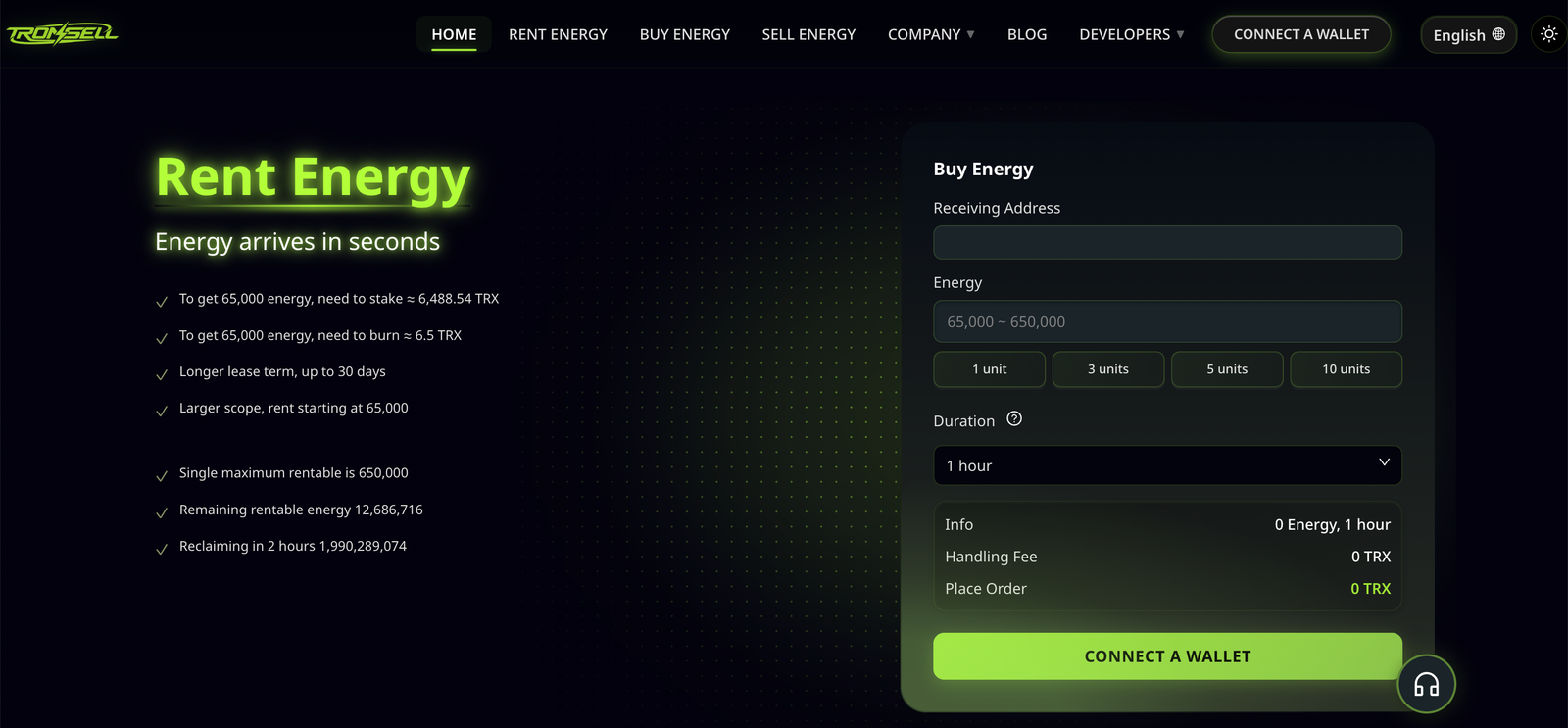
Every quote in this market is denominated in a unit that nobody explains, and the unit is the reason buyers end up with either too much capacity or not enough.
The listing says 65,000. That number is energy, and energy is a quantity of computation, not a number of transfers. The two are related by a conversion that depends on what the transaction does — which means the same 65,000 units supports exactly one USDT transfer, roughly two of something simpler, and none of something more expensive.
Understanding what you are buying when you rent TRX energy is not pedantry. It is the difference between a model that predicts your costs and a model that produces a number you keep having to explain.
What the unit actually is
TRON meters computation in energy and data in bandwidth, and it charges for both. Energy is consumed by smart contract execution; bandwidth by the size of the transaction. They are separate pools, they refill differently, and buying one does not buy the other.
When you rent TRX energy, you are buying a delegation of energy units from someone who has staked TRX. The staking side produces about 9.7 energy per TRX per day, so a provider with a large position can delegate continuously. That is the supply mechanism behind every listing you see when you rent TRX energy, and it is why prices track the cost of staking rather than the level of demand. The delegation is directed at an address, has a quantity, and has an expiry. Those three parameters are the entire product.
What it is not: a number of transactions, a guaranteed success count, a balance you can spend later, or something you can move to another address. Once delegated, the units sit on the receiving address until consumed or until the term ends.
Why 65,000 is a convention rather than a spec
The 65,000 figure circulates because a USDT transfer from an established address costs 64,285 energy, and 65,000 is that number rounded up to something a form can display.
It is a good convention and a bad specification, because the same token costs 130,285 energy from a fresh address, and other TRC-20 contracts cost different amounts entirely. A transfer that writes to a new storage slot, emits several events, or runs a proxy indirection can exceed the USDT figure by a wide margin. The number you need is a property of the contract you are calling, not of TRON.
So the first correction is to stop treating 65,000 as a transfer. It is one transfer of one token from one kind of address. Everything you size from it inherits that assumption, and the assumption fails quietly on exactly the transfers that matter — the first payment to a new counterparty, the payout to a freshly created wallet, the token whose contract is heavier than USDT.
| What the quote says | What it actually commits to | What it leaves out |
|---|---|---|
| 65,000 energy | A delegation of that many units | Whether that covers your transaction |
| 1 hour | An expiry one hour from delegation | What happens to units consumed after expiry |
| Price in sun | Cost per unit, paid in TRX | Bandwidth, activation, failed attempts |
| “Covers one transfer” | A claim about USDT from an established address | New addresses, other tokens, heavier contracts |
Nothing in that table is deceptive. It is just that a quote describes the product and the buyer needs to know the fit, and the fit is never on the page.
The three axes, and only one of them is quantity
Buyers who rent TRX energy tend to optimise quantity because it is the only one of the three with a price attached to it on the page. The other two axes decide whether the quantity was worth buying.
Quantity is how many units. Under-buy and transactions fail against the energy limit; over-buy and the surplus expires. There is no partial refund for the remainder, because the remainder does not exist as an asset once the term ends.
Term is how long the delegation lives. This is the axis people get wrong most expensively, because term has no relationship to consumption. A 30-day delegation of 65,000 units still supports one USDT transfer; the extra 29 days buy nothing. Conversely a one-hour delegation on a batch that takes ninety minutes runs out mid-batch, and the failures land on whichever transfers happen to execute after expiry.
Consumption shape is what the units are spent on. One address running one batch is simple. Five processes sharing one address is not, because delegated energy is available to any transaction from that address, and whichever process runs first spends it. Teams that rent TRX energy for a payout wallet and then use the same wallet for a manual transfer discover this the hard way.
Sizing to the peak rather than the average
The arithmetic of sizing is where the unit confusion becomes expensive, and it comes down to one decision: are you buying for the median transaction or the worst one in the batch.
A batch of 500 transfers where 10% of recipients are new needs 450 times 64,285 plus 50 times 130,285 units, which is about 35.4 million rather than 32.1 million. Sizing on the average leaves the new recipients short, and the failure appears at the end of the batch when the energy pool has been drawn down by everything that ran before.
The same logic applies to contract variance. A basket of five tokens with different contracts has five different costs, and sizing the whole basket at the USDT figure means the heaviest token in the basket fails first. The cheap correction is to measure each token once and use the maximum, not the mean.
Buying to the peak costs more up front and less in total, because the alternative is a retry that consumes energy twice. A failed transfer does not refund its reservation. It consumes it, and then you buy again to send the same payment, which means anyone who rents TRX energy without a peak estimate pays twice for the same transfer.
Three quotes that look identical and are not
Take three listings a buyer might see on the same afternoon, all offering 65,000 energy, all priced within a few sun of each other.
The first is a one-hour delegation. It covers a single USDT transfer from an established address, executed promptly, and expires long before the buyer’s next payment is due. For a team paying out once an hour that is the correct purchase, and it is the cheapest of the three.
The second is a 30-day delegation of the same quantity. It supports exactly the same single transfer, costs more, and the only thing the extra 29 days change is the window in which the buyer can forget to use it. Anyone who has been told to rent TRX energy monthly and cannot explain the term structure is usually holding this one.
The third is not a delegation at all but a guaranteed-transfer product: the provider signs the transfer itself, using its own energy, and charges a flat fee per payment. The unit has quietly changed from energy to transactions. That sounds more useful and is priced accordingly, typically at two to three times the cost of buying the capacity yourself, and it moves delivery risk onto the provider in exchange.
All three are legitimate. The mistake is comparing their prices, because they are not the same thing: one sells an hour of capacity, one sells a month of the same capacity, and one sells an outcome. Sun per unit is meaningless against the third, and against the first two it hides the fact that the longer term buys nothing except a longer window.
What makes this hard is presentation. Quotes in this market are displayed in a way that implies comparability: same quantity, same token, same chain. The differences live in the term and in what is being sold, and neither appears in the number a buyer sorts by. That is the whole reason the unit confusion persists — it is not that the numbers are wrong, it is that they answer a narrower question than the one being asked.
The question to ask before every order
One question resolves most of this: what will consume these units, and what is the largest single consumption in that set?
If the answer is a thousand USDT transfers from established addresses, the quote is fine and the term should match the batch duration. If the answer includes new recipients, a second token, or a shared wallet, the quantity needs to be derived rather than copied, and the derivation takes about two minutes with a block explorer and one test transaction.
There is a second question that is worth asking at the same time, and it is about the term: does the delegation outlive the work. When you rent TRX energy in 30-day blocks for work that finishes in an hour, you are paying for 29 days you will not use, and the per-unit price will look attractive while the per-transfer cost is twenty times the hourly alternative.
Both questions are answerable before payment. Neither is answerable after, which is why the discipline belongs to the ordering step rather than the reconciliation step, and why teams that rent TRX energy on a schedule keep a one-page sizing sheet next to the order form.
What a good order looks like in numbers
Concretely, for 1,000 USDT transfers in a single two-hour batch with 8% new recipients:
- 920 transfers at 64,285 units is 59.1 million.
- 80 transfers at 130,285 units is 10.4 million.
- Total energy about 69.5 million, which is roughly 7,000 TRX of staking equivalent at 9.7 energy per TRX per day, or about 695 TRX of energy at 100 sun.
- Add bandwidth: 1,000 transfers at 345 bytes is 345,000 bytes against 600 free bytes, so about 344,400 bytes at 1,000 sun, which is 344 TRX.
- Add activation: 80 new recipients at 1.1 TRX is 88 TRX.
The energy is 695 TRX and the two lines nobody quotes add 432 TRX, which is 62% on top. That ratio is not unusual for a batch with new recipients, and it is invisible in every quote you will receive when you rent TRX energy, because quotes are denominated in the one unit that happens to be the smallest part of the bill.
For how to measure a token before sizing an order, our notes on what happens when a delegation is not delivered cover the recovery side, and the guide to renting TRX energy starts from the resource model. The measurement itself is two calls against a public node and does not require anything from a supplier.
The short version
You are buying energy units for an address, for a term, at a price per unit. That is the whole product, and none of those three parameters is a number of transfers.
The 65,000 convention is a rounded USDT figure from an established address. It under-counts new recipients by half, does not transfer to other tokens, and says nothing about the term. Size to the largest consumption in the batch, match the term to the duration of the work, and keep one wallet for one purpose. Do that and the unit stops being confusing, because you stop asking it to answer a question it was never designed to answer. Most of the money lost in this category is lost at that gap, by people who rent TRX energy competently and size it from a number that was never a specification.