Rent TRX energy: why this page exists
Renting TRX energy sounds like a single action — pay, receive energy, send USDT — but almost every question people actually ask turns out to be about one of three things: what the real cost is, whether the arrangement is safe, and what to do when the timing goes wrong.
This page answers thirty of the questions people ask before they rent TRX energy for the first time, in the order they come up. The numbers are current as of late 2026 and each one is stated with its basis, so you can recheck it rather than trust it. Where the widely published figure is wrong, the answer says so.
Part 1: the basics
1. What does it actually mean to rent TRX energy?
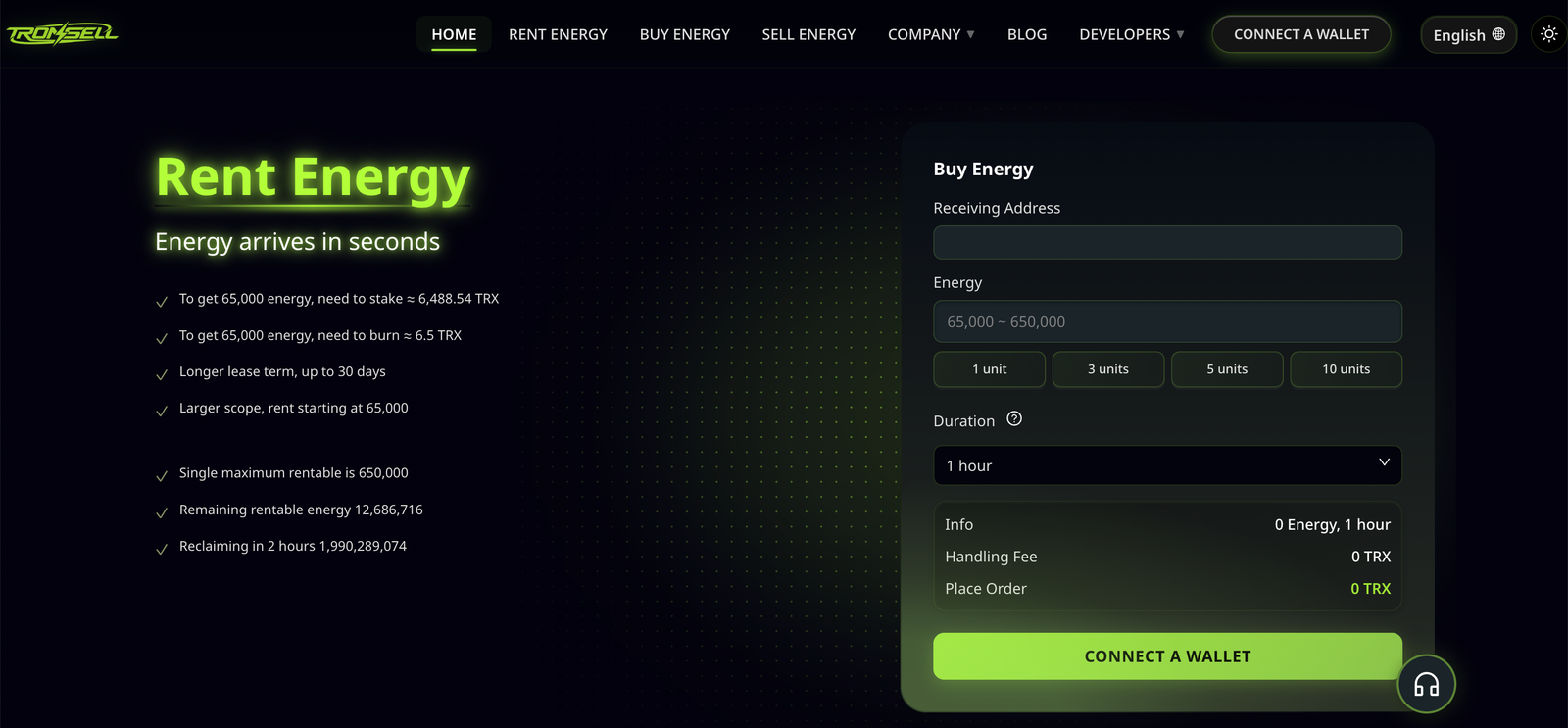
It means another party delegates Energy to your wallet for a limited time. Energy on TRON is a network resource produced by staking TRX, and Stake 2.0 allows a staker to delegate it to any address. A rental platform aggregates delegated Energy from large stakers and resells it in small slices — typically 15 minutes, 1 hour, 1 day, 3 days or 30 days. You never hold TRX, never stake, and never touch the staking interface. The Energy simply appears in your wallet’s resource panel.
2. Why is it called TRX energy when I’m sending USDT?
Because Energy is a property of the TRON network, not of the token you are moving. TRX is the network’s native asset and the thing you stake; USDT is a TRC-20 contract that runs on top of it. Executing that contract consumes Energy, and the network prices Energy in TRX. So the resource is “TRX energy” even when the transfer is denominated in USDT.
3. Do I need TRX in my wallet to rent energy?
You need a small amount, but far less than for burning. Energy covers contract execution; it does not cover bandwidth, which is charged at 1,000 sun per byte. Every account gets 600 free bandwidth bytes per day — enough for exactly one transfer, since two need 690. Keep a few TRX in the wallet for bandwidth and for any energy shortfall, and you will avoid the most common avoidable failures.
4. Can I rent energy to an exchange deposit address?
No, and this trips people up constantly. You can technically delegate to any address, but a deposit address is controlled by the exchange, and the exchange settles withdrawals from its own internal ledger — it does not consume delegated energy on your behalf. If your flow routes through an exchange, you are limited to whatever energy product that exchange offers.
5. Is it different to rent TRX energy or buy it?
Yes, and the distinction matters. Buying energy usually means letting the network burn TRX at the protocol rate — currently 100 sun per unit, set by committee proposal #104, effective 29 August 2025. Renting means paying a third party for delegated energy, which typically clears between 26 and 74 sun per unit. Burning is the ceiling; renting is the market price below it.
6. Is renting energy allowed?
Yes. Delegation is a documented feature of Stake 2.0, not a workaround or a grey-market trick. What can go wrong is not the mechanism but the counterparty — a provider that takes payment and never delegates, or one that asks for your private key. No legitimate energy rental service needs custody of your keys.
Part 2: cost and pricing
7. How much does it cost to rent TRX energy?
Indicative pricing through late 2026 has run from about 26 sun per unit on large monthly orders up to 74 sun on small short-duration orders. Against the 100-sun burn rate, that is a discount of roughly 26% to 74%. Per transfer, renting usually lands somewhere between a quarter and two thirds of the burn cost. Treat any specific number — including these — as a snapshot, not a rate.
8. Why is renting cheaper than burning TRX?
Because stakers hold Energy they cannot otherwise monetise. A staker with surplus capacity has idle inventory; delegation lets them sell it. Competition between providers pushes the price toward their marginal cost rather than the protocol’s burn rate, and the gap between the two is the rental market’s entire reason for existing.
9. How much energy does one USDT transfer need?
Approximately 64,285 Energy if the recipient already holds a USDT balance, and approximately 130,285 Energy if they do not — roughly double, because the token contract has to create a new balance slot for that address. These are measured from confirmed on-chain receipts in 2026, not the older published estimates.
10. Why do so many guides say 31,895 energy?
Because they are repeating a figure that is roughly two years stale. That number, and the 64,895 that goes with it, predates TRON’s dynamic energy model, which adds a surcharge to heavily used contracts. The USDT contract currently carries an energy factor of 34,000 — the network maximum, about 3.4× base cost. If you budget off 31,895, your estimate is wrong by more than half.
11. Is it cheaper to rent TRX energy for longer?
Cheaper per unit, yes. Cheaper in total, only if you use it. A 30-day rental costs less per energy unit than a 1-hour rental because the provider’s revenue is more certain, but delegated Energy refills over roughly 24 hours — so a monthly plan sized for one transfer a day genuinely covers 30 transfers. A monthly plan bought for a single transfer wastes money.
12. How many transfers will one rental cover?
It depends on duration and sizing. Energy regenerates, so a 30-day rental sized at 64,285 Energy covers one transfer per day for the month — 30 transfers, not one. A 1-hour rental covers one transfer. The governing rule is that your energy balance refills over about a day, so size for your daily volume rather than your total volume.
13. How do I calculate how much TRX energy to rent?
Multiply transfers per day by the energy per transfer, using the correct figure for each recipient — 64,285 or 130,285, not an average. Add a 15–25% buffer for variance, then match the duration to your refill cycle. Example: 20 transfers a day to funded recipients is 1,285,700 Energy, so order about 1.54 million on a monthly term with a 20% buffer.
Part 3: mechanics and timing
14. How long after I rent TRX energy does delegation arrive?
Usually under a minute, because delegation is a single on-chain transaction. During network congestion it can take longer. Always confirm the energy balance in your wallet’s resource panel before sending — an order status page saying “completed” is not proof that the delegation landed.
15. What happens when the rental expires?
Delegation is withdrawn and the Energy returns to the provider. Any transfer after that point reverts to burning TRX at 100 sun per unit. There is no grace period and no automatic renewal, so if a batch is scheduled near the expiry time, renew first.
16. Can I extend a rental before it expires?
Usually yes — most platforms let you place a new order that stacks on top of the existing delegation. What you generally cannot do is modify an existing order. Check whether the platform extends or replaces, because replacing can briefly leave you with no energy between delegations.
17. Does unused energy carry over or get refunded?
No. Energy is delegated for a fixed window; whatever you do not consume at expiry goes back to the provider. There is no refund and no carry-forward. This is why sizing matters more than buying a comfortable margin “just in case” — overbuying is a certain loss, whereas underbuying is a possible one.
18. Can I rent TRX energy for someone else’s address?
Yes, if they control the keys to that address. This is common for businesses funding an employee wallet or a partner’s operations. It does not work for custodial addresses, where the venue controls the keys and manages its own resources.
19. If I rent TRX energy, is bandwidth covered too?
No, and this is the omission that makes many “90% savings” claims wrong. Renting covers Energy only. Bandwidth is charged separately at 1,000 sun per byte, about 345 bytes per TRC-20 transfer, with 600 free bytes per account per day. At high volume, bandwidth is a real line item that survives your energy savings untouched.
Part 4: safety and scams
20. Is renting TRX energy safe?
The mechanism is safe; the counterparty risk is real. Delegation is a standard network feature and the transaction is visible on-chain. The risks are operational: paying for delegation that never arrives, sizing a rental that expires mid-batch, or dealing with a provider who disappears. Our guide to the two ways people lose money renting energy covers these in detail.
21. What do the common scams look like?
Three patterns dominate. A provider that collects payment and never delegates, leaving you with no recourse. A “support agent” who offers to fix a failed order in exchange for your private key or seed phrase. And a platform that requires you to import your wallet into its interface, which is simply key theft with extra steps. If any of these appear, stop.
22. Do I have to give my private key to rent energy?
No. Never. Renting requires one thing from you: the address you want energy delegated to. That is a public address, not a secret. Any service asking for a private key, seed phrase or wallet import to receive energy is either compromised or fraudulent.
23. What if I pay and the energy never arrives?
Check the on-chain delegation first — it may simply be delayed. If there is genuinely no delegation after a reasonable wait, you have a support dispute, not a technical one, and your leverage depends entirely on how you paid. This is the practical argument for using established platforms with visible delegation transaction hashes rather than the cheapest quote on a marketplace you have not heard of.
24. Can a provider revoke TRX energy before the rental ends?
Technically the delegator can undelegate at any time, but doing so would be self-defeating for a business that sells time-based rentals. What you should confirm is the platform’s stated policy, and prefer providers where the order terms specify a fixed window. Treat a very cheap quote from an unknown provider as a signal to check that term.
25. Is it risky to rent TRX energy from a small provider?
Smaller providers are not inherently unsafe, but they carry more of two specific risks: inventory risk, meaning they may not have the energy available exactly when you need it, and continuity risk, meaning they may not be around for your next order. For a one-off transfer these are minor. For an operation that depends on daily settlement, use a provider with provable inventory and an API.
Part 5: troubleshooting
26. I rented energy but still got OUT_OF_ENERGY. Why?
The most likely cause is a recipient with no USDT balance. If you sized for 64,285 Energy and the transfer needed 130,285, it fails regardless of the rental. Second most likely: the delegation had not confirmed when you submitted. Third: the rental expired between ordering and sending. Our guide to avoiding OUT_OF_ENERGY errors walks through the diagnosis.
27. My transfer failed — did I lose the energy anyway?
Often yes, at least partially. A transaction that runs out of energy mid-execution may still consume what it used before failing, and you must buy more to retry. This is why underbuying is more expensive than buffering: the buffer costs a little for certain, while a failure costs unpredictably.
28. Energy is showing, but the transfer still burned TRX. Why?
Almost always bandwidth. Energy and bandwidth are separate resources and a transfer consumes both. If your daily 600 free bytes are used up, the overflow burns TRX at 1,000 sun per byte — roughly 0.35 TRX per transfer — even with a full energy balance.
29. The order says complete but my wallet shows zero energy.
Check the wallet’s resource panel rather than its main balance, and confirm you are looking at the same network and address you ordered for. If the panel still shows zero, look for the delegation transaction hash — a legitimate platform can show you one. No hash and no energy means you have not received anything, whatever the order page says.
30. Should I rent TRX energy or stake for long-term use?
Rent, unless you already hold a large TRX position. Staking looks free because no fee leaves your wallet, but covering one 64,285-Energy transfer per day requires roughly 6,700 TRX staked — around $2,200 — locked for 14 days of unbonding if you want out. If you already hold TRX as inventory, staking captures the yield yourself and beats renting. If you would have to buy TRX to do it, you are taking a directional position to save a fee, which is a different decision.
The five answers that matter most
If you remember nothing else from these thirty questions about renting TRX energy, remember these.
A USDT transfer needs 64,285 Energy, or 130,285 to a new recipient. Not 31,895. The dynamic energy model changed this and most guides have not caught up.
Rental clears below the 100-sun burn rate, typically 26 to 74 sun. The discount is structural, not promotional, and it varies enough that how you buy matters as much as whether you buy.
Energy refills, so size by duration. A monthly rental covers a month of daily transfers, not one transfer. Buying per transfer is the most expensive habit in this market.
Bandwidth is not included. 600 free bytes a day covers one transfer; beyond that you burn TRX regardless of how much energy you rented.
Verify the delegation on-chain before sending. An order status is not proof. This single habit prevents the most expensive class of mistake in energy rental.
If you want the operational walkthrough rather than the questions, start with how to rent TRON energy step by step, and if you would rather compare staking properly, this staking walkthrough including the 14-day unbonding covers what that commitment actually costs.