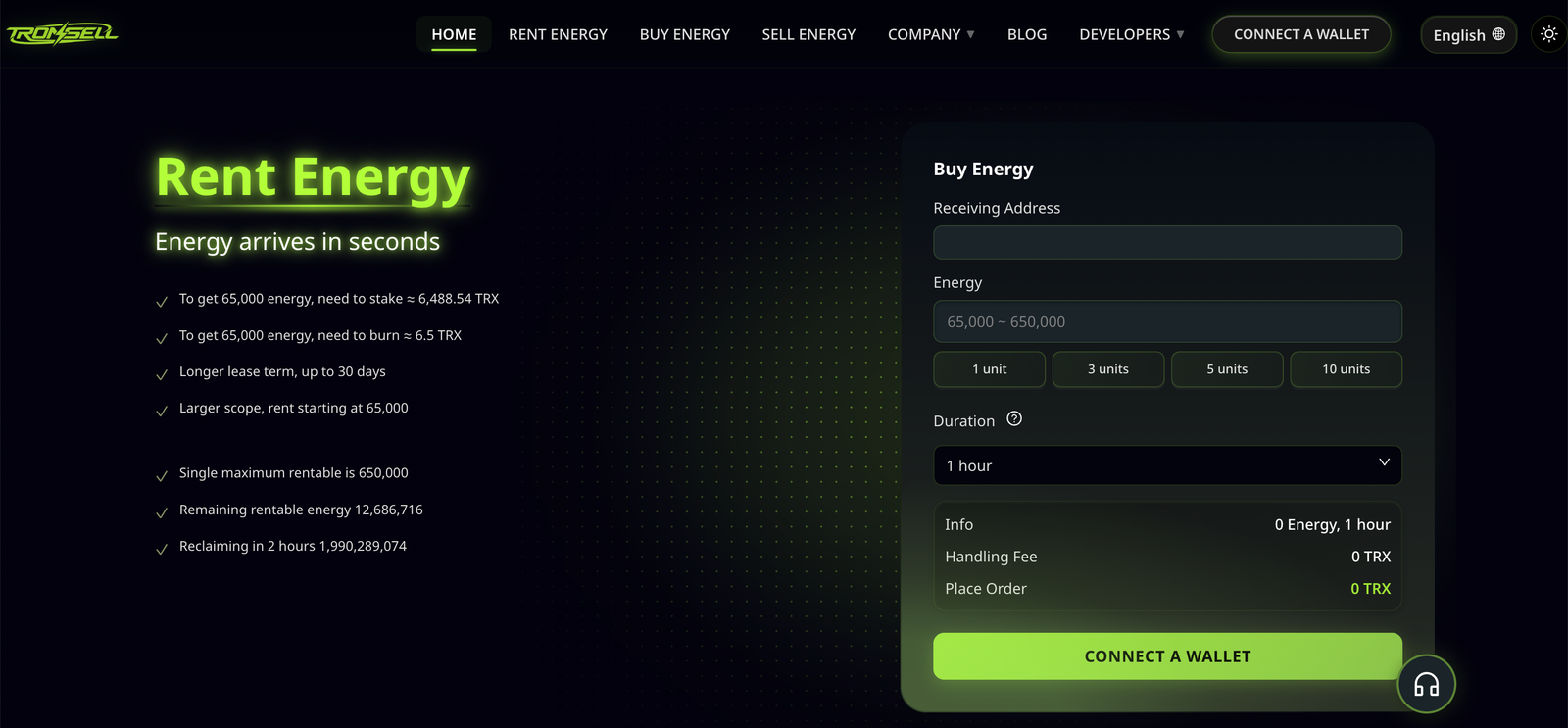
Every article about TRON fees has the same weakness: the numbers were true when it was written. This page is built to be different. It is a reference sheet of the figures that decide what a transfer costs, each with its source and the date it was read, plus the arithmetic that turns them into dollars.
Use it as a lookup. When you need to rent trx energy for a specific workload, find the requirement in the first table, the price in the second, and run the two multiplications in the fourth section. When a number looks wrong, the date column tells you whether the sheet has aged or the site you are comparing against has.
Chain parameters
| Parameter | Value | Read on |
|---|---|---|
| Energy unit price (burn) | 100 sun (0.0001 TRX per energy) | 2026-11-07 |
| Bandwidth unit price (burn) | 1,000 sun per byte (0.001 TRX) | 2026-11-07 |
| Free bandwidth allowance | 600 per activated account per day | 2026-11-07 |
| Free energy allowance | none | 2026-11-07 |
| Daily energy pool | 180,000,000,000 energy | 2026-11-07 |
| Daily bandwidth pool | 43,200,000,000 bandwidth | 2026-11-07 |
| Total energy weight (staked for energy) | 18,483,643,671 TRX | 2026-11-07 |
| Total net weight (staked for bandwidth) | 26,626,259,930 TRX | 2026-11-07 |
| 1 TRX | 1,000,000 sun | fixed |
Everything downstream is derived from these nine rows. The two weights move constantly as holders stake and unstake, so they are the rows most likely to be stale when you read this.
Energy requirements by transfer type
| Operation | Energy | Bandwidth | Burn cost (energy only) |
|---|---|---|---|
| USDT to a wallet that holds USDT | 64,285 | ~345 bytes | 6.43 TRX |
| USDT to a wallet with zero USDT | 130,285 | ~345 bytes | 13.03 TRX |
| Plain TRX transfer | 0 | ~270 bytes | bandwidth only |
The two USDT figures are measured receipts, not parameters, and they are the numbers you will use most often when you rent TRX energy for payments. They reflect the USDT contract’s dynamic energy factor, which sits at its cap of 34,000 — the reason the requirement roughly doubled from the older 31,895 figure still quoted widely. If a guide shows 31,895 or 64,895, it predates the change and will leave you short.
Always confirm against your own transaction: the energy_used field on a recent transfer is the only figure that accounts for your specific recipient state and contract version.
Staking ratios: how much TRX produces how much capacity
Staking does not produce a fixed amount of energy. It produces a share of the daily pool, so the conversion rate depends on how much everyone else has staked:
energy per TRX per day = 180,000,000,000 / total energy weight
At today’s weight: 180,000,000,000 / 18,483,643,671 = 9.7383 energy per staked TRX per day.
For bandwidth: 43,200,000,000 / 26,626,259,930 = 1.6225 bandwidth per staked TRX per day.
Two things follow. First, older tutorials quoting 280 energy per TRX are off by nearly thirty times today, and any calculator built on that figure is unusable. Second, the ratio falls as more TRX is staked — your stake’s output is not a property of your stake, it is a property of the network.
To size a stake for a given daily workload, divide the workload by the ratio:
| Daily workload | Energy per day | TRX to stake | Value at $0.3175 |
|---|---|---|---|
| 1 transfer, holder | 64,285 | 6,601 | $2,096 |
| 1 transfer, empty wallet | 130,285 | 13,379 | $4,248 |
| 100 transfers, holder | 6,428,500 | 660,100 | $209,582 |
| 10,000 transfers, 78/22 mix | 788,050,000 | 80,923,000 | $25.7M |
That last row is why the rental market exists: when you rent TRX energy, you are paying for capacity someone else locked up. Covering ten thousand daily transfers by staking requires locking roughly $25.7 million of TRX; renting the same capacity costs on the order of $16,600 a month. The comparison is not close, and it is not a temporary market inefficiency — it is the arithmetic of a fixed pool.
Sun to dollars in two steps
Quotes arrive in sun, budgets are in dollars, and the conversion has two multipliers that are easy to apply in the wrong order.
Step one, sun to TRX: energy × price in sun = cost in sun, then divide by 1,000,000.
Step two, TRX to dollars: multiply by the TRX/USD rate at a stated timestamp. At $0.3175 on 2026-11-07:
| Basis | Energy | Sun cost | TRX | USD |
|---|---|---|---|---|
| Burn (100 sun), holder | 64,285 | 6,428,500 | 6.43 | $2.04 |
| Burn (100 sun), empty wallet | 130,285 | 13,028,500 | 13.03 | $4.14 |
| Rental at 62 sun, holder | 64,285 | 3,985,670 | 3.99 | $1.27 |
| Rental at 62 sun, empty wallet | 130,285 | 8,077,670 | 8.08 | $2.56 |
| Bandwidth, per transfer | 345 bytes | 345,000 | 0.345 | $0.11 |
The bandwidth row belongs in every comparison and almost never appears, yet it is charged whether you burn or rent TRX energy. It is 5–6% of the cost at small scale and slightly more at large scale, and it cannot be rented in practice — so it is burned either way.
The five numbers that decide whether to rent TRX energy
Instead of a flowchart, five checks. If any of them comes out against you, the decision is made before price matters.
- Energy required per transfer — is your recipient mix known, or are you using the holder figure for everyone? A 22% empty-wallet tail raises the blend to 78,805.
- Burn cost per transfer — multiply by 100 sun. That is your do-nothing baseline, and no rental quote above it is rational.
- Available rental quote in sun — below 100 to be worth doing; below 80 to be worth the operational overhead of a counterparty.
- Provisioning latency — how long between order and usable energy? If it exceeds your transfer interval, you need buffer capacity, and buffer expires.
- Capital cost of staking instead — TRX to stake × your cost of capital. For most operators this is the number that rules staking out, and for a few it does not.
Worked examples at three scales
One transfer. If you rent TRX energy for a single transfer, this is the comparison that decides it: burn 6.43 + 0.345 = 6.78 TRX, $2.15. Rent at 62 sun: 3.99 + 0.345 = 4.34 TRX, $1.38. Saving $0.77 — real, but not worth setting up an account for unless you already have one.
One hundred transfers, all to holders. Burn: 677.5 TRX, $215. Rent: 433.5 TRX, $138. Saving about $77 a month, or roughly the value of one hour of someone’s time. Still marginal.
Ten thousand transfers, 78/22 mix. Burn: 82,260 TRX, $26,118. Rent: 52,310 TRX, $16,608. Saving about $9,500 a month, or 36%. This is the scale at which rental stops being a cost optimisation and becomes the operating model — and the scale at which you should stop ordering by hand.
The progression is the point: the same decision changes character between one transfer and ten thousand, and the crossover — the volume at which it becomes worth the effort to rent TRX energy — is driven by fixed overhead rather than by rate. If you want the operational version of this sheet — the checks to run before each order rather than the parameters — see the pre-flight checklist.
When the parameters change
Three of the rows above have moved recently enough to matter, and knowing the direction of travel prevents stale models.
The energy unit price has been rewritten nine times since genesis, with a 42-fold spread between the 10 sun low and the 420 sun peak of December 2022. It has been 100 sun since 29 August 2025, when a governance proposal halved it from 210. A model built before that date will overstate the energy line and, if it also used the old requirement, understate it in a second place — the two errors can offset in aggregate and hide each other.
The energy requirement per USDT transfer roughly doubled when the contract’s dynamic energy factor reached its cap. This is the single most commonly missed update in the ecosystem, and it is why figures like 31,895 still circulate.
The staking ratio drifts continuously as the total weight changes. It is not a governance event, so it never makes news, and it silently moves every stake-sizing calculation on the internet.
Requirements beyond USDT transfers
The tables above cover the case most people need, but energy requirements vary widely by contract call, and a sheet that only lists USDT invites mis-sized estimates elsewhere. Order-of-magnitude figures worth knowing before you rent trx energy for anything unusual:
| Operation | Energy (approximate) | Burn at 100 sun |
|---|---|---|
| USDT transfer, recipient holds USDT | 64,285 | 6.43 TRX |
| USDT transfer, recipient balance zero | 130,285 | 13.03 TRX |
| Other TRC-20 token transfer | 30,000–70,000 | 3–7 TRX |
| DEX swap on a TRON venue | ~100,000 | ~10 TRX |
| Contract deployment, simple | 100,000–150,000 | 10–15 TRX |
| Contract deployment, complex | 200,000–300,000 | 20–30 TRX |
Treat every row below the first two as an estimate rather than a receipt. Contract code changes; the USDT figure is stable enough to plan against because the token is immutable, but a DEX swap’s cost depends on the route it takes at that moment. If you are sizing a one-off operation, simulate it first — most wallets show a fee estimate before you confirm, and that estimate is worth more than any table.
One structural point that catches people provisioning for the first time: energy is consumed by the contract call, not by the amount transferred. Sending 10 USDT and sending 10,000 USDT cost the same energy. That is why the per-transfer cost is essentially flat and why batching is not a cost lever in the way it is on some other chains — ten transfers consume ten times the energy of one, regardless of value.
Six ways this sheet gets misread
Reference tables fail in predictable ways. These are the six, each with the correction.
Reading the requirement as a constant. 64,285 applies to a recipient who already holds USDT. Use it for a fresh wallet and you will be short by half, and the shortfall burns at 100 sun. Classify the recipient before you multiply.
Multiplying energy by the rental quote when the job is small. Rental has fixed overhead — minimum orders, durations, account setup. At one transfer a day the overhead exceeds the saving, and the correct answer is to burn.
Forgetting bandwidth. Every comparison that omits the 0.345 TRX per transfer overstates the saving by 5–6%. It is small per transfer and not small per month.
Using a stale staking ratio. The 9.7383 figure is a snapshot of a moving quantity. Anyone sizing a stake from a table — including this one — should re-read getaccountresource first, because the ratio drifts with every large staking move.
Treating the burn price as fixed. Nine resets since genesis, a 42-fold spread. A model that hard-codes 100 sun will be wrong, eventually, and the error will be large rather than small.
Converting at an unstated rate. Sun to dollars passes through TRX, and the TRX rate moves. Any dollar figure without a timestamp is a rumour: the same 6.43 TRX transfer was $2.04 at $0.3175 and $2.57 at $0.40.
If you take one habit from this page, make it the timestamp. The reason these numbers are useful is that each one says when it was read. That single column is what separates a reference sheet from a blog post that was approximately right two years ago — and it is what lets you decide, in five seconds, whether you can still rent trx energy against a figure you found here.
Version log
Keep this page’s date in view when you use it. A sheet without a read date is a rumour with tables.
| Sheet version | Read date | Changes |
|---|---|---|
| 1.0 | 2026-11-07 | initial parameter set: 100 sun energy, 1,000 sun bandwidth, 9.7383 ratio, 64,285 / 130,285 requirements, TRX $0.3175 |
If you are checking this sheet against reality, the three calls that matter are GetEnergyPrices, GetBandwidthPrices and getaccountresource — all public, all fast, and all more current than any article. Use them to confirm before you rent trx energy against a figure you read here, and treat a mismatch as a signal that the sheet needs updating rather than that the chain is wrong.
For the safety side of renting — who can sign what, and how delegation is abused — the signing rule that prevents most losses covers it. For the full picture of what renting involves beyond the numbers, start with the overview of renting TRX energy.