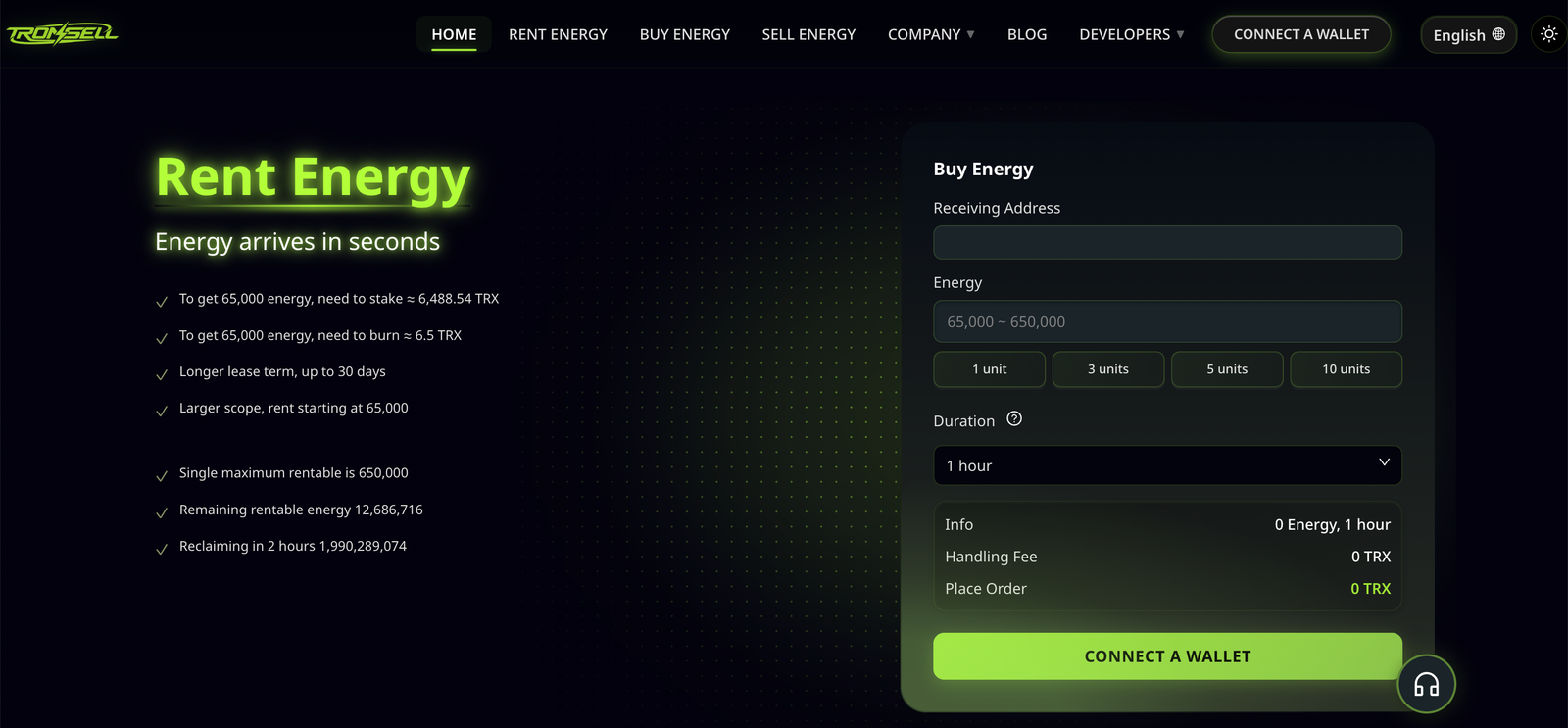
Energy rental is unusual among crypto services in one respect: the safe way to rent TRX energy requires almost nothing from you. No transaction to sign, no contract to approve, no wallet to connect. You name an address, someone delegates energy to it, and it appears.
That property makes the category easy to secure and easy to fake. The legitimate flow is so undemanding that any provider asking for more is asking for something it does not need — which is exactly the gap that gets exploited.
This article covers the mechanics honestly, including where the real risks sit, which are not where most checklists put them.
First, what delegation actually is
When you rent TRX energy, the provider stakes its own TRX for energy and delegates that energy to your address. Delegation is a chain-level operation on the provider’s side. Nothing moves out of your wallet. Your private key is not involved. Your TRX balance is unchanged. Your address does not need to hold any TRX at all.
When you rent TRX energy, the energy arrives with an expiry. When the delegation window ends, the resource is reclaimed automatically and any unused energy is gone — it does not accumulate, and it is not refunded.
That is the entire mechanism behind every legitimate service that will rent TRX energy to you. It has one immediate consequence worth stating plainly: receiving energy is not something you do. It is something that happens to an address you nominate. There is no acceptance step.
The rule that prevents most losses
If you take one thing from this article, take this:
If a flow asks you to sign a transaction or approve a contract in order to receive energy, stop. That is not energy rental.
Every legitimate provider can delegate to any address without your cooperation, which is why the sequence to rent TRX energy has never needed a signature. A request for a signature, an approve, a wallet connection with write permissions, or a “claim” step is either a badly built product or a drain. From the outside the two look identical, and the outcome is the same for you.
The subtle version of this attack is well constructed. It presents a familiar interface, shows a plausible order summary, and asks for an approval “to authorise the delegation”. The approval is for USDT, with an amount that is either unlimited or far above the order value. Once granted, the allowance can be exercised at any time, by anyone holding it, without further interaction from you.
This is why the rule is absolute rather than a judgement call. You cannot evaluate a malicious approval by looking at the interface, and you do not need to — the legitimate product never asks.
The three failure modes that actually cost money
Ranked by observed frequency rather than by severity.
1. Paid, never delegated. The most common loss is not a hack. It is an off-chain payment to a provider that does not deliver. Because nothing is enforced on-chain, your only protection is the provider’s behaviour. This is why reputation is load-bearing in this category and why “we have a Telegram support channel” is not a control.
2. Approved something you should not have. Covered above. The damage is not limited to the order — an unlimited allowance persists after the order expires, after the provider disappears, and after you stop using the service.
3. Delegated to the wrong address. Human error, and increasingly address poisoning: an attacker sends a zero-value transfer from an address that shares the first and last characters of a counterparty you have paid before, so it appears in your history. You copy the wrong one. The energy lands on an address you do not control, and the transfer you funded fails.
Notice what is absent from that list: someone stealing your private key via a rental service. That does happen in this ecosystem, but through generic phishing rather than through the rental mechanism. Treating rental as inherently dangerous misallocates attention; treating it as inherently safe misallocates it worse.
Verifying that energy actually arrived
When you rent TRX energy, do not trust an order page. Read the account. Three values answer the whole question:
- Available energy on your address. If it is at or above your requirement, the delegation landed.
- Delegated-in energy, by source address. Confirms it came from the provider you paid, not from somewhere else.
- Expiry. Confirms you have the window you paid for, which matters more than the amount when your cadence is slower than the delegation window.
A practical habit: verify with a fresh read immediately before releasing any batch that depends on the energy. Not because providers routinely fail, but because the check is nearly free and it converts a payment failure into a delayed payment.
The specific reads and what each field means are set out in the guide to how renting TRX energy works end to end, including how expiry interacts with batch timing. This article is about not losing funds; that one is about not losing time.
What a legitimate flow looks like, step by step
Because the safe pattern for renting TRX energy is so minimal, it is worth spelling out what normal looks like. If a provider’s flow contains a step that is not here, that step is the thing to examine.
- You supply an address. You generate it, or you use an existing one. You read it in full before pasting it anywhere.
- You state a quantity in energy. Not “one transfer” — an energy amount, or a transfer count the provider converts using an energy assumption you can check.
- You pay. Off-chain by invoice or on-chain by a plain TRX transfer. A plain transfer sends TRX; it grants nothing. There is no approval step in either case.
- The provider stakes and delegates. This happens entirely on their side, from their address, using their TRX.
- Energy appears on your address. You confirm by reading account resources. There is no claim, no swap, no receipt to sign.
- The delegation expires. The energy is reclaimed automatically. There is nothing to cancel and nothing to unsubscribe from.
Six steps, zero signatures from you, zero contract approvals. That is the complete legitimate surface area of renting TRX energy.
Now consider the inverse — the shape of a flow that is not what it claims. It asks you to connect a wallet with write access. It presents a “claim energy” button. It requires an approve before the delegation “can be authorised”. It offers to “verify ownership” by having you sign a message that turns out to be a transaction. Each of those steps exists to obtain something the real product does not need, and the thing being obtained is access to your balance.
The distinction is not about how professional the interface looks. A drain can be better designed than a legitimate service, because design is cheap and the payoff is asymmetric. The distinction is entirely about whether your key is asked to do anything, and in the legitimate case the answer is no.
One caveat worth stating plainly: this rule protects you from malicious flows, not from unreliable providers. A provider can follow the correct pattern and still fail to delegate after you have paid. That risk is commercial rather than technical, and the only controls are counterparty selection, small first orders, and verifying delivery on chain before sending a large batch.
Separate the treasury from the spender
The highest-leverage structural change for most teams that rent TRX energy costs nothing and prevents the worst outcome.
Whenever you rent TRX energy, it must land on the address that signs transfers, which is a hot wallet with a key in memory. Your treasury is a cold address that should never sign anything automatically. If those are the same address, every compromise of the payout system is a compromise of the whole balance.
The correct shape is three layers:
| Layer | Holds | Signs | Exposure |
|---|---|---|---|
| Cold treasury | Most of the balance | Manual, rarely | Should never be reachable by automated systems |
| Hot wallet | One or two batches of working balance | Automatically | Acceptable loss ceiling |
| Energy | Nothing — a resource, not a balance | N/A | Worst case, wasted spend |
Energy belongs on the hot wallet, and only on the hot wallet. It is a consumable, not an asset worth protecting in cold storage. The tempting mistake is to delegate energy to the treasury address “because that is where the funds are” — which pulls your cold address into the signing path for no benefit.
For anything above a few batches of working balance, put the hot wallet behind a multisig or a policy-controlled signer. This also changes the failure calculus on approvals: a compromised signing key in a single-key setup drains the wallet, while in a 2-of-3 it drains nothing.
Approval hygiene, if you have ever approved anything
Nothing about renting TRX energy creates an allowance, but if you have used DeFi on the same addresses you already have some outstanding. They are independent of any rental service and they outlive it.
Two habits close this off. First, review and revoke allowances periodically on any address that holds a balance — most wallets and several public tools list outstanding approvals per token and per spender. Second, never grant an unlimited allowance. A specific amount is nearly always sufficient, and it caps the damage at that amount.
On the spender side, treat any address that once held an approval as tainted even after revocation, and prefer a fresh address for new high-value flows. Address history is a record of who has tried what.
If you think you have been drained
Order of operations matters, and the wrong first move wastes the window.
- Revoke approvals first, before anything else. An active allowance is a live faucet. Revoking stops ongoing loss even if the attacker still has other access.
- Move remaining funds to a new address you generate yourself — not an address someone sent you, and not one copy-pasted from history.
- Do not “recover” via any service that asks you to sign or to enter your seed phrase. Recovery scams target exactly this moment, and they arrive within minutes of a public incident.
- Check whether an energy delegation was the vector by reviewing approvals and recent delegations. If it was not, look at what you signed in the preceding days rather than the preceding minutes.
Nothing in that list requires a provider’s cooperation, which is the point. If your recovery plan depends on a vendor responding, it is not a plan.
A short checklist before you rent TRX energy
- The provider delegates to an address you name, with no signature from you.
- You have confirmed the recipient address by reading it in full, not by matching first and last characters.
- Delegation is verified by reading account resources, not by the order page.
- Energy is delegated to the hot wallet, never to the treasury.
- You know the expiry, and it covers your batch window.
- No approval of any kind was granted during the process.
- Outstanding approvals on the sending address have been reviewed in the last 90 days.
None of this is sophisticated. The security posture of renting TRX energy is mostly a matter of refusing to do things you never needed to do — which is harder than it sounds, because interfaces are built to make extra steps feel like diligence. The provider that asks for one more confirmation is not being careful. It is asking you to lower your defences to match the appearance of theirs.